
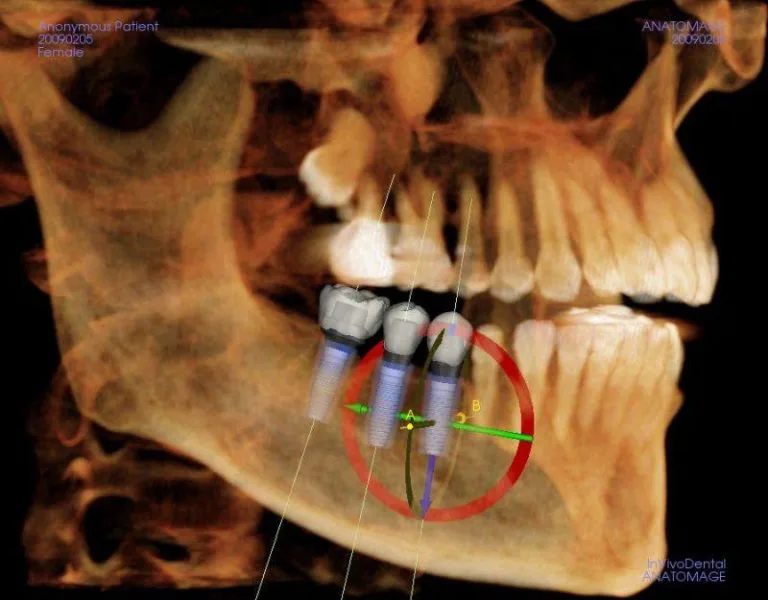
This is general patient information about two full-arch implant approaches. It is not a diagnosis, and which approach suits you can only be decided by a dentist who has examined you and your imaging.
Quick Answer
All-on-4 and All-on-6 are both ways of fixing a complete arch of replacement teeth onto dental implants, so the teeth are screwed in place rather than taken out like a denture. All-on-4 uses four implants per arch, typically with the two back implants angled to avoid anatomy such as the sinus or the nerve and to reach better bone. All-on-6 uses six implants, which spreads the load across more support points and leaves a margin if one implant ever has a problem. Neither is simply better. The number of implants follows from how much bone you have and where, the jaw being treated, your bite and your habits. A plan that offers the two as price tiers without explaining your bone is a plan to question.
Key Takeaways
- Both approaches are full-arch fixed restorations. The difference is the number and position of implants supporting the arch.
- Bone volume and quality decide more than preference. Where bone allows six well-placed implants, six gives more redundancy. Where it does not, angled implants in All-on-4 may avoid grafting.
- The upper and lower jaw are different. Bone in the upper jaw is often softer, which is one reason some plans use more implants there.
- Heavy bite forces and grinding are a reason to discuss more support, not less.
- Ask what happens if one implant fails, in each design, before you choose.
What the Two Approaches Have in Common
Both replace all the teeth in an arch with one fixed bridge supported by implants. Both usually start with an examination, imaging and a plan for any remaining teeth. Both can, in suitable cases, use a provisional fixed arch fitted soon after the implants are placed, followed later by a definitive arch once healing allows. Both need the same care afterwards: daily cleaning under and around the bridge, and professional maintenance where the arch may be removed by the dentist for cleaning and checks.
If you are new to full-arch treatment, read All-on-4 dental implants and All-on-6 dental implants first. This article is the comparison between them.
Side by Side
| All-on-4 | All-on-6 | |
|---|---|---|
| Implants per arch | Four | Six |
| Typical implant position | Two front, two back implants often angled | Implants spread along the arch, usually more upright |
| Main reason it is chosen | Uses available bone and can avoid some grafting where bone at the back is limited | More support points and load distribution where bone allows |
| If one implant has a problem | Fewer remaining supports, so the arch may need to be modified or the implant replaced before use | More remaining supports, which may give more options while the problem is managed |
| Surgery | Fewer implant sites | More implant sites |
| Bone requirement | Can work with less bone in the back of the jaw | Needs enough bone in more positions |
| Suited to | Decided per case after imaging | Decided per case after imaging |
The last row is deliberate. Neither design has a universal patient profile, and you should be cautious of any source that says otherwise.
Why Bone Decides More Than Preference
Implants need bone of sufficient height, width and density. After teeth have been missing for some time, or after gum disease, the bone shrinks. In the upper jaw the sinus can sit close to where back implants would go, and in the lower jaw the nerve that supplies sensation to the lip runs through the bone.
All-on-4 was developed partly to deal with exactly that: by tilting the two back implants, it reaches bone further forward and avoids the sinus or nerve, which in some patients avoids a bone graft or sinus lift. All-on-6 places more implants, which needs adequate bone in more positions. If that bone exists, the extra support is generally seen as an advantage. If it does not, six implants may require grafting first, which adds time and another procedure.
That is why the decision is made from three-dimensional imaging and an examination, not from a brochure. See panoramic X-ray or CBCT for why full-arch planning commonly involves CBCT.
Other Factors That Matter
- Which jaw. The upper jaw generally has softer bone than the lower jaw, and some clinicians prefer more implants in the upper arch for that reason.
- Bite force and grinding. People who clench or grind put higher loads on any restoration. See teeth grinding and bruxism.
- Smoking and health conditions. These affect healing and long-term implant success regardless of the number of implants. See smoking and dental implants and health conditions and medicines to tell your dentist about.
- The opposing arch. A full-arch bridge biting against natural teeth or another implant bridge behaves differently from one biting against a removable denture.
- Whether a removable option would suit you better. Some patients are better served by an implant-supported overdenture, which uses fewer implants and comes out for cleaning.
What Happens If One Implant Fails
No implant is guaranteed. This question is worth asking for either design. With six implants, losing one usually leaves five supports, and the clinician may have more options while the site is managed. With four, losing one leaves three, and the arch may need to be modified, the implant replaced, or the plan revised before the arch is used normally again. Ask how the plan handles that scenario, what it would involve and how it would be charged. For warning signs to watch for, see dental implant failure warning signs.
Questions to Ask Before You Choose
- Why this number of implants for my upper jaw, and why for my lower jaw?
- What does my imaging show about bone at the back of each jaw?
- Would six implants require grafting in my case, and would four avoid it?
- Which implant system will be used, and what are the manufacturer's warranty terms? See how implant warranties work.
- What is the provisional arch, when is the definitive arch made, and how many visits does that mean? See two-trip treatment planning.
- What happens, and what does it cost, if one implant does not integrate?
How Adil Dent Approaches It
Full-arch cases at Adil Dent Clinics start with photographs and any imaging you already have, sent on WhatsApp. That allows preliminary information, not a final plan. The final treatment plan, including the number of implants per arch, the procedures and the agreed cost, is given in writing after you have been examined in person and any necessary imaging has been taken. See the dental implants treatment page for how the clinic plans implant treatment.
Adil Dent Clinics works with implant systems from several manufacturers, including Swiss and American brands. Each implant comes with its manufacturer’s certificate and documentation and carries that manufacturer’s warranty, and the system chosen for you is named in your written treatment plan.
Conclusion
Four or six is the wrong first question. The right first question is what your bone allows and what your bite demands. Once those are clear, the number of implants usually follows, and a good plan explains it to you in plain words.
Considering full-arch treatment? Send your photos and X-rays on WhatsApp or request a consultation.