
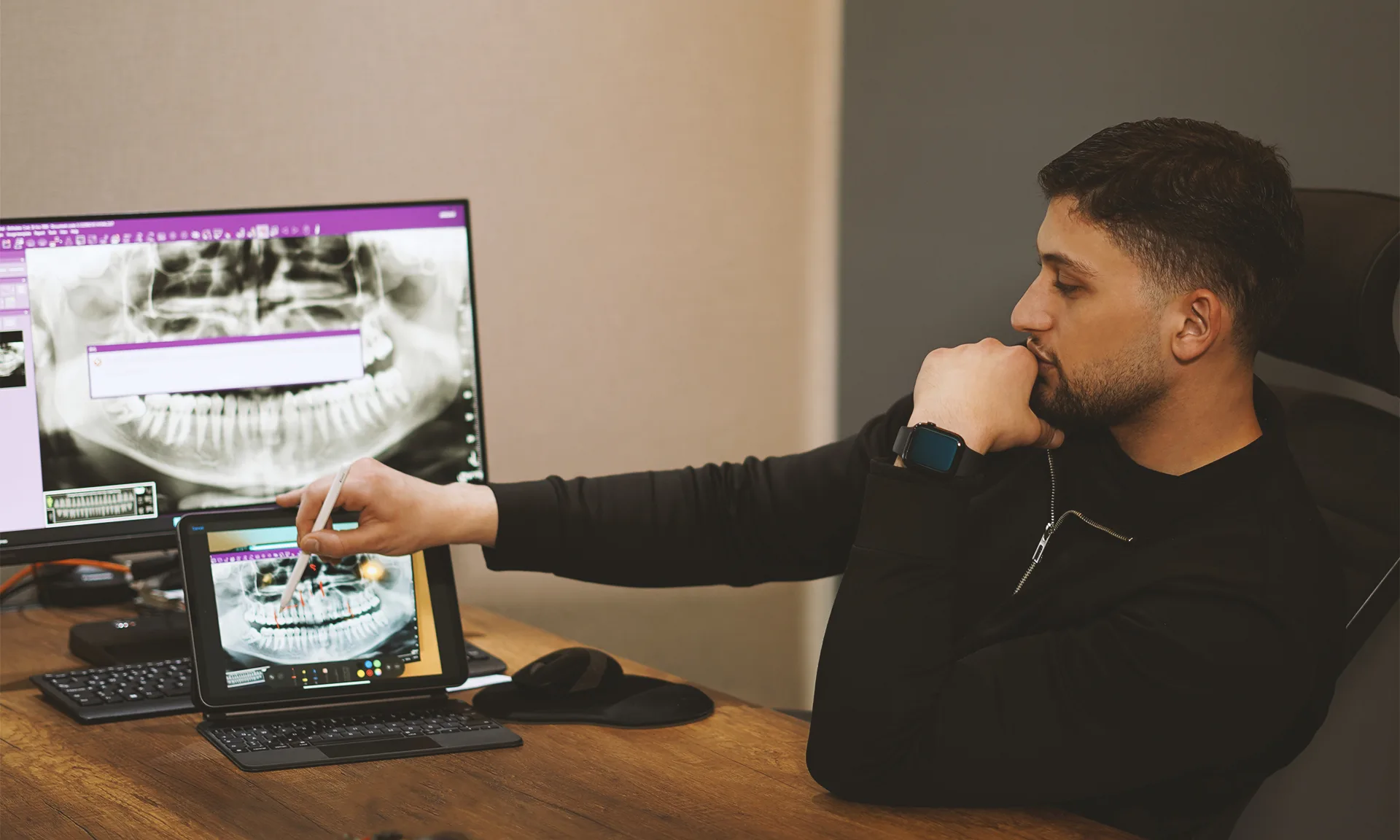
An international dental case almost always begins with a message. It is quick, it is free, and it is also where expectations are set — which means it is worth knowing what that exchange can legitimately produce before you read anything into it.
This article covers the enquiry stage only: from your first message to the point where travel dates start being discussed.
Quick Answer
After a first WhatsApp message, a clinic can answer treatment-related questions, give preliminary information about the treatment that may be appropriate, discuss the expected duration of treatment, discuss cost, and explain the steps that would follow. It will usually ask for clear photographs of your teeth and a frontal photograph of your smile, and depending on the case, a panoramic X-ray or a CBCT scan. What it cannot give you is a diagnosis or a final treatment plan — both of those follow an in-person examination. At Adil Dent Clinics the stage ends when a preliminary plan is agreed and travel arrangements start being coordinated.
Key Takeaways
- A useful first message is short and specific: the problem, the goal, your rough timing, and any photographs or images you already have.
- Everything you receive before an examination is preliminary, including the cost figure.
- You should get the steps explained, not just a price.
- The clinic asks for photographs first; further imaging depends on your case and the proposed treatment.
- If a clinic sends a fixed, final-sounding plan before seeing you, that is a reason to slow down, not to book.
What to Put in the First Message
Four lines do more than four paragraphs.
- What is happening — pain, a missing tooth, a loose crown, an old bridge, how your front teeth look, whatever it is.
- What you want — a specific outcome if you have one, or an honest "I do not know yet, I want options".
- When you could travel — a month or a window, not an exact date.
- What you already have — photographs, a recent X-ray, a plan from another clinic, a report from your own dentist.
If you have records already, say so rather than attaching everything at once. Formats and file quality matter, and how to prepare photos and X-ray files for an online assessment covers getting them out of your dentist's system intact.
What the Clinic Can Answer at This Stage
| You can reasonably expect | Why it is possible remotely |
|---|---|
| Answers to treatment-related questions | General treatment information does not require an examination |
| Preliminary information about likely treatment | Based on what you describe and send, with its limits stated |
| Expected duration of treatment | Typical sequencing is known once the likely treatment is known |
| Discussion of cost | Costs can be discussed and estimated before the plan is confirmed |
| An explanation of the required steps | The process itself is fixed, whatever your diagnosis turns out to be |
| You should not expect | Why not |
|---|---|
| A diagnosis | Diagnosis requires clinical examination, and usually imaging |
| A final treatment plan | The final plan is confirmed after the examination |
| A promise about the outcome | Outcomes depend on findings that have not been made yet |
| Confirmation that a quoted total cannot change | The plan can change after examination, and cost follows the plan |
What You Will Be Asked For
Initially: clear photographs of your teeth, and a frontal photograph showing your teeth and your smile. Those two cover a surprising amount of ground for a first conversation about appearance, and they also show whether there are obvious signs that need a closer look.
Depending on your individual case and the treatment being discussed, the clinic may also request a 2D panoramic dental X-ray, or a CBCT (3D tomography) scan. Not every patient needs the same imaging — what is required depends on your condition and the proposed treatment. The reasoning behind which image answers which question is in panoramic X-ray versus CBCT, and whether to arrange anything before you travel is in do I need an X-ray before travelling.
Photographs do not diagnose anything. They direct the conversation.
Five Answers Worth Having in Writing
Before dates enter the conversation, make sure you can scroll back and find these.
- What treatment is being considered, and what are the alternatives. One option is a recommendation; two or three is a conversation.
- Roughly how long it would take, and how many visits. Visit count drives your whole travel plan.
- What the cost discussion is based on, and what would make it change.
- What happens on arrival, in order — examination, imaging if needed, then plan confirmation.
- What is explicitly not yet decided. A clinic willing to say "we cannot know that until we examine you" is giving you better information than one that answers everything.
The Moment the Conversation Has to Stop
At some point the useful remote work is finished. You know what is likely, roughly how long and roughly what it costs; the clinic knows what it needs to examine. Continuing to negotiate detail by message after that point does not add accuracy — it only makes the preliminary plan feel more final than it is.
At Adil Dent Clinics, once a preliminary treatment plan is agreed, travel and reservation arrangements are coordinated with you. You book your own flight; hotel arrangements and transfers between the airport, hotel and clinic are organised by the clinic. According to the clinic's current policy, no deposit or advance payment is required before you travel, so the decision to travel does not have to be bought in advance. Who arranges what is set out in who books the flight, hotel and transfers.
Signs the Enquiry Is Going Well, and Signs It Is Not
Going well: your questions are answered rather than deflected; limits are stated out loud; the records request is specific; the steps are explained before the price; nobody is in a hurry.
Not going well: a final-sounding plan and a fixed total arrive before anyone has looked at an image; the only reply is a price list; pressure to decide quickly; the person answering cannot say whether a dentist has seen your photographs. On the last point, how to verify an Istanbul dental clinic is the right next read, and agency, platform or clinic explains who you may actually be messaging.
A Note on Sending Photographs
You are sending health information to a business in another country. Ask who will see it, how long it is kept, and how to ask for it to be deleted. That is a reasonable question, and the answer tells you something about the clinic regardless of what it is.
Conclusion
The enquiry stage is where you find out how a clinic communicates, which is worth as much as the estimate it produces. Treat the numbers as provisional, keep the thread, and move to an examination when the remote conversation has given you everything it honestly can.
Ready to start one? Message the clinic on WhatsApp or request an appointment. The next step after the enquiry is explained in preliminary information versus a final treatment plan, and the whole route is mapped in the international patient journey.