
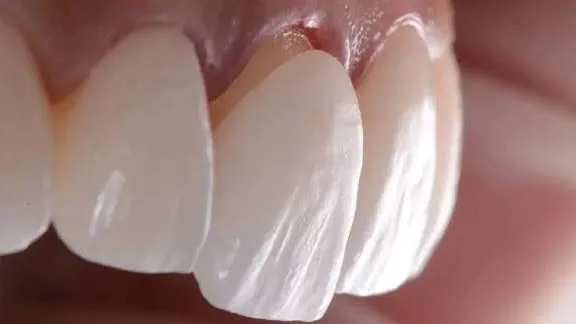
Most patients agree to a smile plan without ever being told the one number that decides how reversible it is: how much tooth is being removed. This article is about that number.
Quick Answer
Tooth preparation exists on a spectrum. Minimal or no-preparation veneers remove very little enamel, or none. Conventional porcelain veneers remove a thin layer from the front surface and edge. Full crowns require reduction on every surface of the tooth. Only the no-preparation end is reversible, and only in principle. Everything else commits the tooth to being restored for life, with replacement every time the restoration reaches the end of its service. Which one is right depends on the condition of the tooth, the bite, the position and how much change you want. That is a clinical decision made after examination and imaging, and it should be recorded tooth by tooth in your treatment plan.
What Each Option Removes
No-preparation or minimal-preparation veneers. Very thin ceramic bonded with little or no enamel removal. They are only possible in specific situations, typically where teeth are not crowded or protruding and the change wanted is modest. Adding thickness to the front of a tooth without preparing it makes the tooth slightly bigger, which is exactly why it does not suit every case.
Conventional veneers. A thin, controlled reduction of the front surface and biting edge to make room for the ceramic, so the finished tooth is the right size and the margins sit correctly against the gum. Enamel is removed, and it does not regenerate.
Crowns. The tooth is reduced on all surfaces so the crown fits over it entirely. This removes substantially more structure than a veneer and, in teeth with a large existing filling, root canal treatment or a fracture, is often the correct answer precisely because there is not enough sound tooth left to support anything less.
The treatment-by-treatment comparison is in dental crowns versus veneers, and the material choice sits on top of it in zirconia versus E.max crowns.
Why Some Clinics Default to Crowns
Crowns tolerate imperfection. Once the tooth is reduced on all sides, alignment problems, rotations and shade differences become easier to correct by shape alone, and the laboratory has more room to work with. That makes a whole-arch case faster and more predictable to deliver in a short visit.
That is a scheduling advantage, not a clinical indication. Where a tooth is healthy and well-positioned, using a crown to solve something orthodontics or a veneer could have solved trades tooth structure for speed. That trade-off is the mechanism behind many of the cases discussed in the honest answer to "Turkey teeth gone wrong".
What Preparation Commits You To
Once a tooth is prepared:
- It needs a restoration permanently. There is no going back to an unrestored tooth.
- The restoration has a service life and will need replacing, and each replacement involves further preparation.
- The tooth may become more sensitive, particularly in the period after preparation.
- If preparation goes close to the pulp, the tooth may later need root canal treatment, which is discussed in root canal treatment.
- The gum margin matters for the rest of the tooth's life, and margin placement is one of the main determinants of long-term gum health around the restoration.
None of that is an argument against veneers or crowns. It is an argument for knowing which one you are getting and why.
Alternatives Worth Ruling Out First
Before agreeing to irreversible preparation, ask what these would achieve in your case:
- Whitening, where the complaint is colour rather than shape. See teeth whitening in Istanbul.
- Orthodontics, where the complaint is position. Aligners move the teeth you already have; see clear aligners and our orthodontics service.
- Composite bonding, an additive repair for chips and small gaps.
- Gum recontouring, where the issue is the frame rather than the teeth.
- Treating fewer teeth, which is very often the honest answer.
A plan that never mentions any of these has not been individualised. If you want yours read against these alternatives, send it on WhatsApp or book a consultation.
Make the Clinic Write It Down
Ask for a plan that states, for every tooth:
- The tooth number.
- Crown, veneer, bonding, or no treatment.
- The clinical reason for that choice on that tooth.
- Whether the tooth is currently vital and whether root canal treatment is anticipated.
- The material to be used.
- Whether the preparation is reversible (it is not, except in genuine no-preparation cases).
- What alternative was considered and why it was not chosen.
A serious clinic will produce that. It is the same document that lets any dentist in the world take over your care later.
The Provisional Stage Is Not Optional
Well-run cosmetic cases include temporary restorations that you wear, eat with and look at before the final ceramics are made. That stage exists so shape, length and bite can be adjusted while adjustment is still free. If a proposed schedule has no provisional stage, ask when the bite is verified. The design process is described in digital smile design, and realistic scheduling in how many days in Istanbul.
References
- World Health Organization: Oral health fact sheet
- General Dental Council (UK), guidance for patients
- NHS, dental services and finding a dentist
- FDI World Dental Federation
This article is general educational information. It is not a diagnosis and does not replace a clinical examination. How much preparation any tooth needs, or whether it needs any, can only be decided after examination and imaging by the clinician treating you. To have a plan reviewed, book a consultation or message us on WhatsApp.